

Good Morning!
Welcome to this week’s edition of Grinfi Political Risk Edge, your trusted source for expert political risk analysis and strategic intelligence. Thorough, insightful, and industry-focused. We deliver clarity in uncertainty and strength in decision-making. Anticipate, Adapt, and Excel!
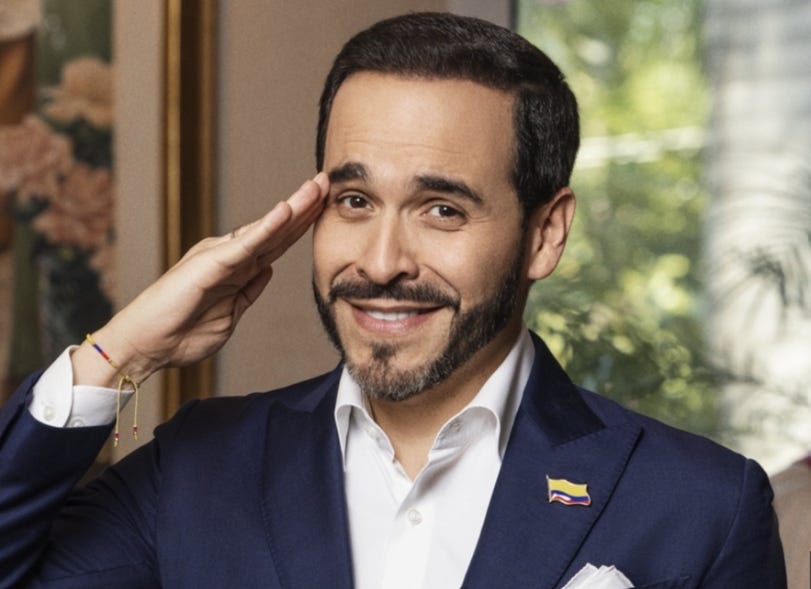
Now, on a lighter note, let’s start the week with a laugh 😄 to brighten the mood. Remember, a little humor never hurts before moving on to the serious stuff.
From Grinfi Political Risk Observatory (GPRO), here’s what we’re monitoring:
High Impact Situational Updates
“At Grinfi, we track immediate fragility and systemic contagion to ensure leaders see risks before they spread.”
EXECUTIVE SUMMARY
Here are the key issues that are expected to shape political risk this week.
The first round results of Colombia’s presidential election, held yesterday, May 31, took a surprising turn. Abelardo de la Espriella, a right-wing lawyer and political outsider, emerged in first place ahead of left-wing Senator Iván Cepeda, the candidate of President Gustavo Petro’s ruling coalition. The established Uribista right and the moderate center were eliminated.

Abelardo de la Espriella was not expected to win the first round. Every major poll published in the final weeks of the campaign had him running second or third, with support ranging between 25% and 31%. Iván Cepeda, the candidate of President Gustavo Petro’s Historic Pact coalition, consistently led the field with 40% to 45% support. The establishment right, represented by Uribista Senator Paloma Valencia, was widely seen as de la Espriella’s main competitor for the anti-Petro vote.
Instead, de la Espriella secured 43.73% of the vote, with more than 99% of ballots counted. Valencia collapsed to below 7%, while Cepeda finished with 40.92%. Both de la Espriella & Cepeda advanced to the June 21 runoff as the only viable contenders. Colombia is now headed toward one of the most ideologically polarized presidential contests in its modern democratic history.
But who is de la Espriella?
He is 47 years old, a lawyer by training, and a political newcomer who has never held elected office. He built his political movement, Defenders of the Homeland, on a platform of tougher security policies, reduced state intervention, and aggressive counternarcotics enforcement. He has spoken favorably of Donald Trump, described Nayib Bukele as a model leader, and campaigned directly against Petro’s “Total Peace” strategy with armed groups. His surprise first round performance suggests that voters seeking change did not divide their support between him and Valencia. Instead, they consolidated behind the candidate they believed was most capable of delivering it.
More than a contest between the two candidates, the June 21 runoff is set to showcase two fundamentally different visions for Colombia’s future. Whichever candidate prevails, a large share of the electorate is likely to be dissatisfied with the outcome.
Beyond the electoral outcome itself, the key question is how Colombia’s risk environment could change under either candidate? A de la Espriella presidency would likely produce the most pro-Washington Colombian government since Álvaro Uribe. He would almost certainly reinstate aerial coca eradication, restore full counternarcotics cooperation with the DEA, and align more closely with US policy toward Venezuela and Cuba. Such a shift could trigger a stronger response from FARC dissident factions and the ELN as armed groups resist renewed security pressure.
A Cepeda victory, by contrast, would likely extend Petro’s left wing agenda, including the Total Peace framework and a more distant relationship with Washington on counternarcotics policy. This would likely mean continued uncertainty in cocaine producing regions, ongoing pressure from the United States over drug policy, and a foreign policy orientation more closely aligned with regional left-wing governments.
Colombia remains the world’s leading cocaine producer, Washington’s most important security partner in Latin America, and a critical component of any regional strategy involving Venezuela. The June 21st runoff will determine the direction of that partnership for the next four years. The next president will take office on July 7.
The runoff arithmetic currently favors de la Espriella. He won the first round by nearly three percentage points despite polling more than 10 points behind only weeks earlier, and much of Valencia’s support is expected to shift toward the anti-left candidate. However, first round momentum does not always translate into victory against a consolidated left wing base. The race is now entering its most intense phase.
President Gustavo Petro has since expressed skepticism about the results. He wrote:
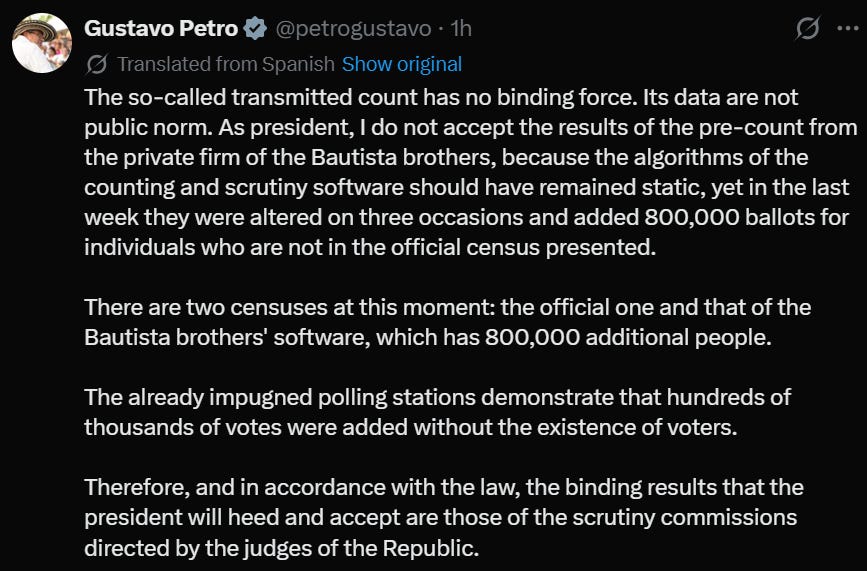
In fact, even before the results were announced, Petro had spent months questioning the integrity of the electoral system. On election day itself, he posted allegations of “corruption rings” within the registrar’s office on social media, raising the possibility of a legitimacy dispute that could complicate the political transition regardless of who wins the runoff.
At the same time, this past week marked arguably the most intense period of US-Iran diplomacy since the war began in late February. By Thursday, May 28, negotiators had reached a tentative memorandum of understanding that would extend the ceasefire by