

Good Morning!
Welcome to this week’s edition of Grinfi Political Risk Edge, your trusted source for expert political risk analysis and strategic intelligence. Thorough, insightful, and industry-focused. We deliver clarity in uncertainty and strength in decision-making. Anticipate, Adapt, and Excel!
But first, let’s begin the week with a laugh 😄 to brighten the mood. Remember, a little humor never hurts before moving on to the serious stuff.
From Grinfi Political Risk Observatory (GPRO), here’s what we’re monitoring:
High Impact Situational Updates
“At Grinfi, we track immediate fragility and systemic contagion to ensure leaders see risks before they spread.”
EXECUTIVE SUMMARY
Here are the key issues that are expected to shape political risk this week.
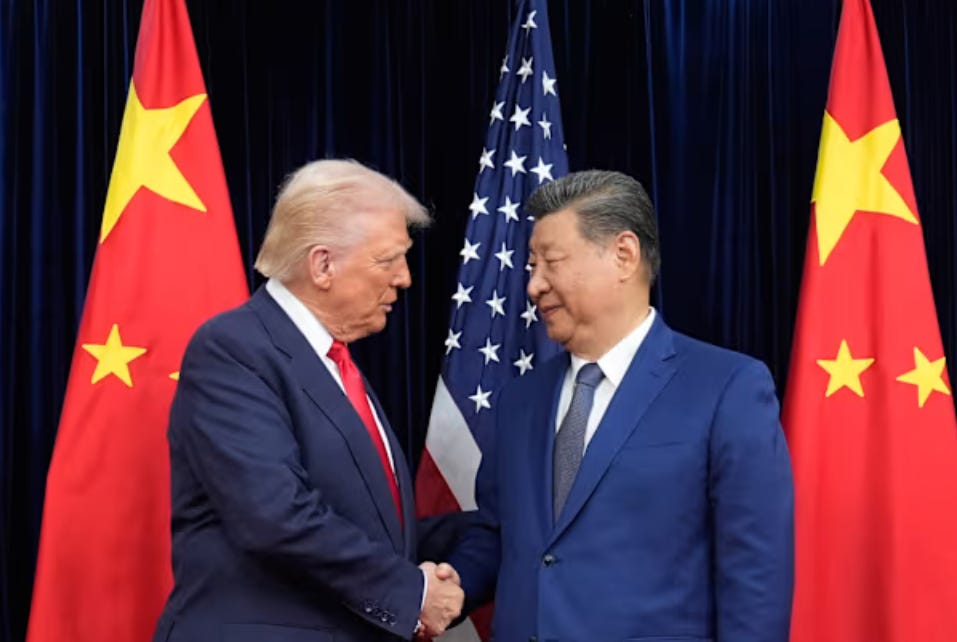
Trump departs for Beijing on Wednesday for the May 14-15 summit with Xi Jinping, the first US presidential visit to China since 2017. The likely deliverables are expected to be transactional. All eyes are on potential Chinese purchases of Boeing aircraft and agricultural goods, a bilateral Board of Trade, and an extension of the November 2025 Busan trade truce.
Meanwhile, China appears to be armed with real leverage. Its exports grew 21.8% year-on-year in the first two months of 2026. Beijing has wielded its rare earth dominance to force two US tariff retreats, is buying more than 80% of Iran's shipped oil, and is arriving at the table as an active mediator in the Iran war. In contrast, Trump's approval rating has fallen to 36%, driven by $4.27 national gasoline prices, 4.5% PCE inflation, and a conflict of his own making, among others.
Undoubtedly, what’s clear at the moment is that Xi's confidence is palpable, while Washington's need for a win is urgent. At the same time, the Taiwan question still remains the X-factor.
In the Middle East, the supposed US-Iran MOU has hit a new wall. Iran delivered its formal counter-proposal to the US on Sunday via Pakistani mediators. Iranian state television reported that Tehran rejected the US framework as amounting to surrender. Iran’s counter-proposal did not address the nuclear program. Trump rejected it the same evening in two Truth Social posts: first accusing Iran of