

Good Morning!
Welcome to this week’s edition of Grinfi Political Risk Edge, your trusted source for expert political risk analysis and strategic intelligence.
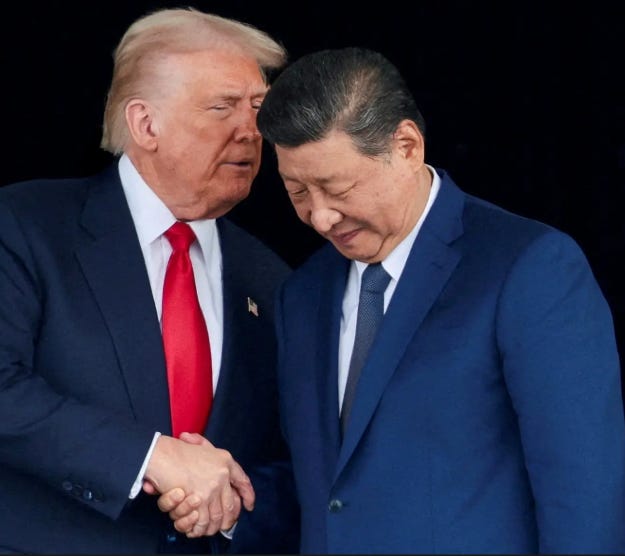
Now, on a lighter note, let’s start the week with a laugh 😄 to brighten the mood. Remember, a little humor never hurts before moving on to the serious stuff.
High Impact Situational Updates
From Grinfi Political Risk Observatory (GPRO), here are the key issues that are expected to shape political risk this week.
China–United States | Critical minerals: Beijing has announced a temporary suspension of certain export restrictions on dual-use materials destined for the United States, including gallium, germanium, antimony and superhard materials. The suspension will take effect on November 28 and remain in place until January 27, 2027. Restrictions on graphite exports will also be eased.
Taiwan | Local elections: Voters will head to the polls on Saturday, November 28, to elect local officials across Taiwan’s cities and counties. The vote also includes a national referendum on whether the government should use nuclear power to support economic development and abandon its non-nuclear energy policy.
Spain | General election: Spaniards vote on Sunday, November 29, in an election that could reshape the country’s political direction. Recent polling places the conservative People’s Party ahead of Prime Minister Pedro Sánchez’s Socialists, with the far-right Vox potentially playing a decisive role in determining the next government’s parliamentary majority.
Major macroeconomic releases and central bank decisions: Nigeria’s Central Bank held its benchmark interest rate at 23% today, abandoning expectations of a possible 50-basis-point cut amid renewed pressure on the naira and concerns over inflation.
On Wednesday, the US is expected to publish its PCE inflation and personal income data, alongside third-quarter GDP, while the Federal Reserve releases its Beige Book. Australia’s October CPI figures are also due. On Thursday, the Bank of Korea is widely expected to raise its benchmark rate by 25 basis points to 3.25%, supported by strong semiconductor exports and persistent inflationary pressure. US markets will be closed for Thanksgiving.
Situation this morning. Nvidia has reinstated Jensen Huang as its president and chief executive, just eleven (11) days after his resignation. The board announced the decision on Monday, November 23, following a unanimous vote. The reversal came after direct intervention by President Donald Trump, who acknowledged speaking with the company’s board and Huang.
Nvidia said the board had received input from senior US government officials and was satisfied that Huang’s return posed no national security risk. Harvey Jones will remain chairman of the board, while Colette Kress, who had served as interim CEO, has returned to her role as chief financial officer. The decision marks a dramatic reversal and raises fresh questions about the circumstances surrounding Huang’s departure.
Huang resigned on November 12 after acknowledging personal misconduct and amid allegations involving Alice Huang, a Chinese businesswoman suspected by US officials of having links to Chinese intelligence. The intelligence claims remain inconclusive, and the independent investigation commissioned by Nvidia is continuing.
The company has also established a separate National Security and Export Control Committee to oversee trade compliance and national security risks. It is recruiting a chief compliance officer to strengthen oversight of regulatory and trade compliance. Huang’s return therefore does not bring the investigations to an end. Nvidia has also confirmed that it will continue cooperating with government inquiries.
Trump’s intervention is particularly significant. He has argued that Huang’s experience is essential to American technological competitiveness and that losing him could have benefited China’s AI ambitions. He also acknowledged that he intervened because of concerns about what was happening to the company.
But what is particularly puzzling is what Trump and Xi actually discussed in Shenzhen regarding Huang and the Nvidia crisis? US Treasury Secretary Scott Bessent confirmed that the allegations involving Jensen Huang and Alice Huang were not discussed during the bilateral meeting. This, however, appears to contradict Trump’s own account. Trump indicated that he and Xi had discussed the case at length. So, what exactly was discussed, and why do the two accounts differ?
In fact, according to Trump, Xi praised Huang, saying, “Oh, brilliant, brilliant! He’s a brilliant man,” and expressed support for giving him