


Francisco Rodríguez, economist and former head of the Economic and Financial Advisory Office at the Venezuelan National Assembly (2000–2004)
Situation as of this morning: Oil prices are up roughly 2% in early trading after U.S. forces struck Iranian rocket launchers on Larak Island yesterday. Brent crude rose above $90 a barrel, while U.S. West Texas Intermediate also gained more than 2%. The strike was the first known American military action against Iran in more than a month, and came after U.S. officials said the Islamic Revolutionary Guard Corps was preparing to launch rockets carrying sea mines into the Strait of Hormuz.
Iran’s IRGC said the Sunday strike on Larak Island caused casualties and vowed retaliation. Hours later, Iran launched a combined ballistic missile and drone attack on two U.S. air bases in Jordan (King Hussein and Al Azraq). Iranian officials noted that the attacks targeted maintenance infrastructure and areas where fighter jets were stationed. A tanker was also struck by an unidentified projectile while transiting the Strait of Hormuz on Sunday. Shipping data showed that vessel traffic through the strait had fallen to just five transits a day over the weekend.
The U.S. pre-emptive attack yesterday comes on the heels of an already alarming week. Last week, an IRGC-linked Iranian state television channel aired a video titled “Where to Kill Barron Trump?” In the video, the IRGC claimed to track the movements and security arrangements of President Trump’s 20 year old son and reportedly provided details about his whereabouts. It also offered a $10 million bounty for his assassination. The threat has prompted the Secret Service to take the matter seriously, particularly as political tensions in the United States continue to rise.
At the same time, Israeli Prime Minister Benjamin Netanyahu’s son Yair was urgently evacuated from Miami and returned to Israel after Israeli security officials identified a significant threat to his life. The evacuation came days after Netanyahu said that Iran had attempted to assassinate one of his sons.
But first, let’s head to South America,
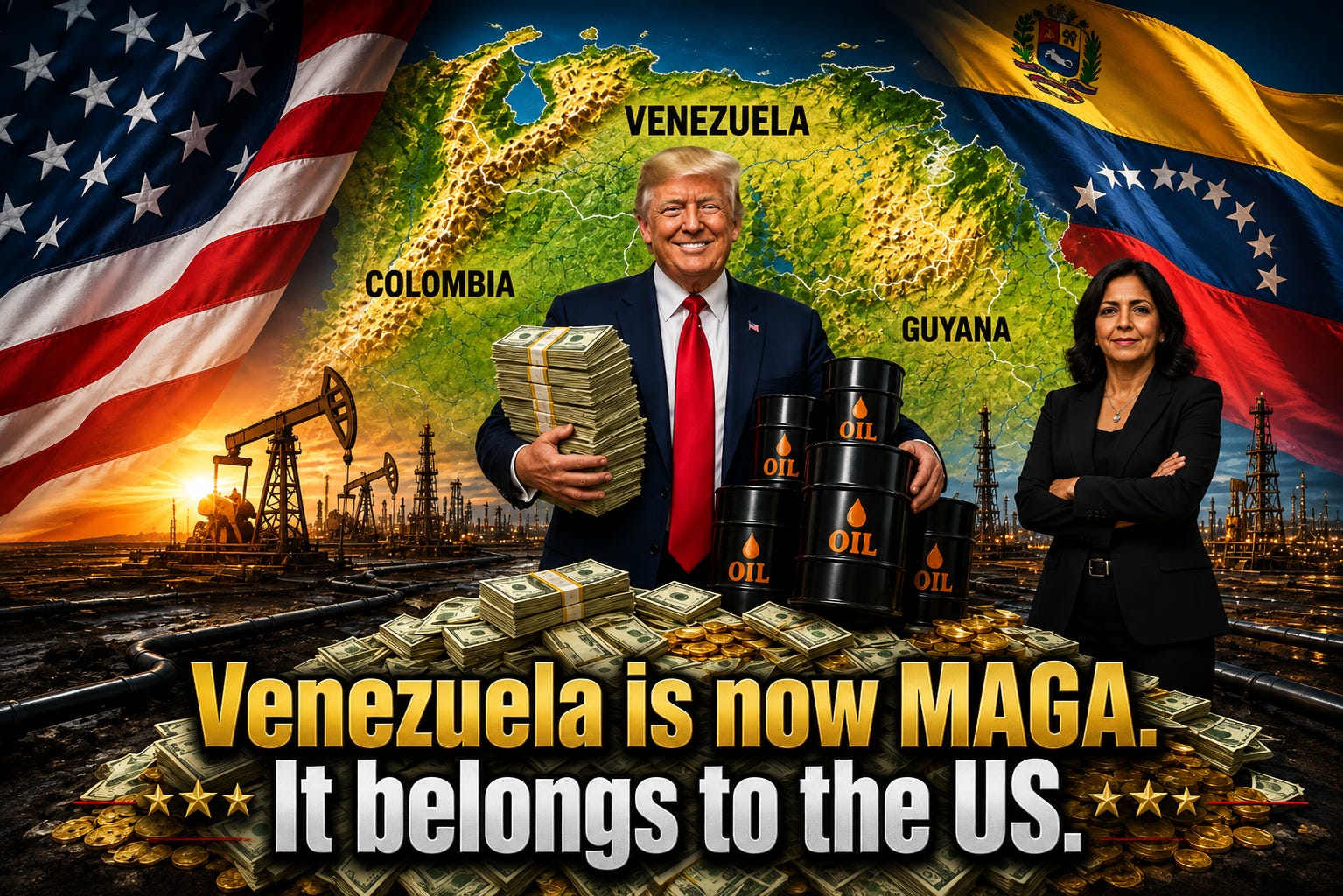
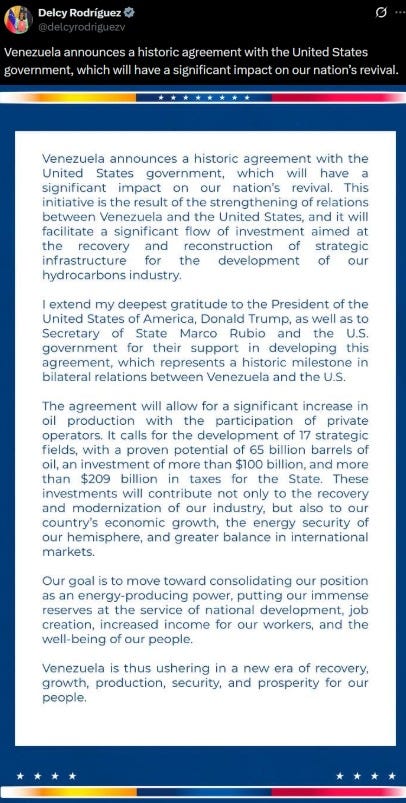
Authorities in Caracas have confirmed that Venezuela has signed a sweeping oil agreement giving Washington majority control over 65 billion barrels of proven reserves, spanning 17 strategic fields, in a deal interim President Delcy Rodríguez called “historic” and central to the “rebirth of the nation.”
Rodríguez said Saturday that the 25-year agreement targets crude output of 1.5 million barrels a day, up from Venezuela’s current 1.23 million, the highest level since 2019. She estimated state revenue at roughly $209 billion over the life of the deal, based on a $65 benchmark oil price, with about $19 a barrel flowing directly to Venezuela. The United States secures 55% of production from the fields, blending equity stakes with below-market purchase rights earmarked for the U.S. strategic reserve and military. Chevron is reportedly among the companies expected to finalize terms to fold its existing joint ventures into the new framework.
The situation, however, has raised serious constitutional questions. Venezuela’s 1999 Constitution (Constitución de la República Bolivariana de Venezuela) states plainly in Article 12, that “mineral and hydrocarbon deposits of any nature that exist within the territory of the nation... are the property of the Republic, are of public domain, and therefore inalienable and not transferable.” Article 302 reserves the petroleum industry to the state “for reasons of national expediency,” while Article 303 says the state shall retain all shares of PDVSA “for reasons of economic and political sovereignty and national strategy.”
Rodríguez’s government argues that a 2026 amendment to the Organic Hydrocarbons Law permits operational access contracts like this one without violating those provisions, since ownership of the reserves technically remains with the state even as the U.S. secures majority control of production and revenue. But, as some critics have pointed out, this appears to be a pedantic distinction without much of a difference. In fact, Harvard economist Ricardo Hausmann, a former Venezuelan planning minister, called it a “shameful deal,” declaring that Rodríguez “has no legitimacy or constitutional power to commit Venezuela to any such deal.”
The deal is the clearest marker yet of how far Venezuela has moved under Washington’s orbit since U.S. forces captured Nicolás Maduro in a January raid and installed his former vice president, Rodríguez, as interim leader. Nearly nine months on, oil exports to the U.S. have surged to a seven-year high near 630,000 barrels a day, while shipments to China and India have fallen sharply as cargoes are redirected north.
But the new agreement’s headline revenue promises sit uneasily alongside an older, unresolved and jarring question. Where is the oil money already collected?
A Financial Times investigation in July found that Washington had generated roughly $13 billion in Venezuelan oil revenue since the January takeover, yet only about $300 million had been