

Good Morning!
Welcome to this week’s edition of Grinfi Political Risk Edge, your trusted source for expert political risk analysis and strategic intelligence.
Now, on a lighter note, let’s start the week with a laugh 😄 to brighten the mood. Remember, a little humor never hurts before moving on to the serious stuff.
High Impact Situational Updates
From Grinfi Political Risk Observatory (GPRO), here are the key issues that are expected to shape political risk this week.
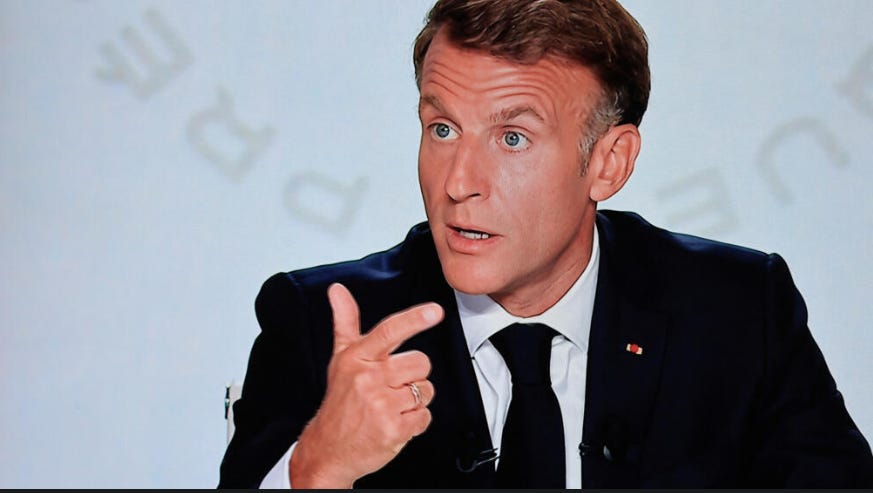
Emmanuel Macron announced last Thursday that France will deploy soldiers, radar platforms and other military assets to protect Saudi energy infrastructure at Yanbu, one of the kingdom’s main oil export terminals on the Red Sea, just two days after telling the UN that Gaza was “a scene that shames us all” and asking what credibility the world has left if it “remains inactive.” Is Macron making a costly political calculation that protecting Gulf energy supplies is essential to France’s energy security, especially as winter approaches and next year’s election draws closer?
Benjamin Netanyahu used his UN General Assembly address last week to call Gaza genocide allegations “the biggest lie of the century,” and to attack New York’s mayor by name as delegates staged a mass walkout.
Trump and Xi Jinping concluded a three-day Washington summit Friday having extended their trade truce, but with little movement on AI governance, Taiwan or long-term trade.
Brent crude has jumped to about $107 a barrel in early trading after Trump rejected Iran’s conditional offer to reopen the Strait of Hormuz, and told aides he expects US strikes to resume after November’s midterms. Oil is up more than 17% in September, after a commercial vessel was struck in the Strait last Wednesday, killing one crew member.
The Rassemblement National formed its first-ever group in the French Senate on Sunday, while La France Insoumise won its first two seats there, and the centre-right kept its majority.
Germany’s final state election results confirmed Chancellor Friedrich Merz’s CDU failed to enter the Mecklenburg-Vorpommern legislature at all, its worst postwar result, while the AfD topped the poll with 38.2% and the far-left Die Linke won Berlin outright for the first time. Is Germany’s political center still capable of holding?
Situation this morning. The French are eagerly awaiting the final tally today, after early results from yesterday’s Senate election produced several historic firsts and signalled that next year’s presidential election could be more closely contested than previously thought.
The most significant is that the Rassemblement National (RN), alongside its UDR allies, cleared the 10-senator threshold needed to form an official group in the upper house for the first time in its history. Public Sénat projects the group will have at least 14 seats. Marine Le Pen called it a “historic victory” and said the breakthrough was “general,” while Jordan Bardella said the new group would give a voice to “forgotten territories” and rural mayors.
La France Insoumise (LFI) also entered the Senate for the first time, ten years after its creation, with Gabriel Amard elected in the Rhône and Marc Péré in Haute-Garonne. The overall balance, however, did not change. The right and center are expcted to retain the majority they have held since 2014. Les Républicains are expected to fall from