

Good Morning!
Welcome to this week’s edition of Grinfi Political Risk Edge, your trusted source for expert political risk analysis and strategic intelligence.
Now, on a lighter note, let’s start the week with a laugh 😄 to brighten the mood. Remember, a little humor never hurts before moving on to the serious stuff.
High Impact Situational Updates
From Grinfi Political Risk Observatory (GPRO), here are the key issues that are expected to shape political risk this week.
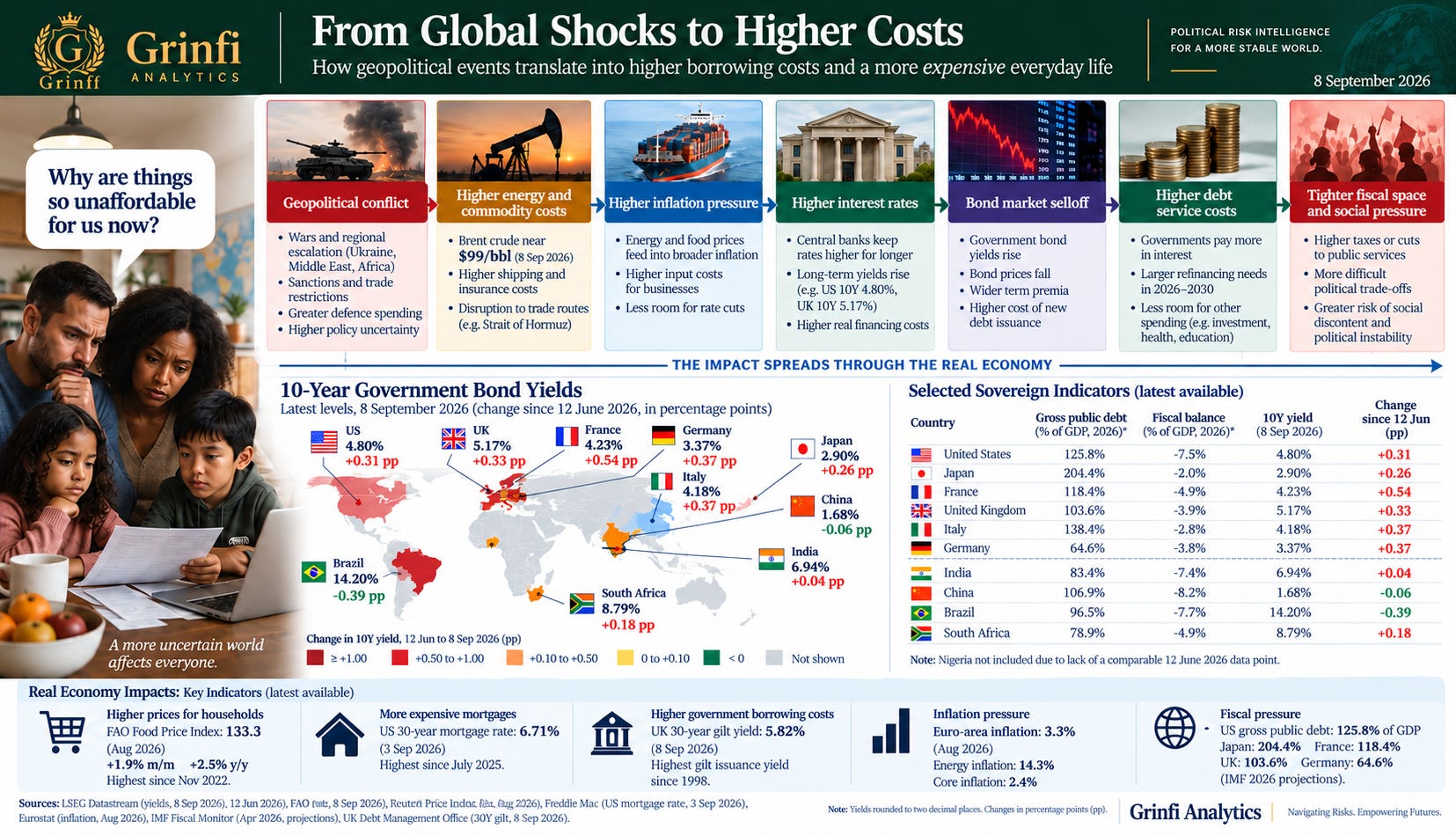
I’m sure no one at this dining table mentions the OAT Bund spread. But in a way, they are feeling its effects. They are more concerned about higher mortgage payments, a grocery bill that keeps going up, and the feeling that their income does not go as far as it once did. In short, the cost of living is rising while wages remain stagnant and, in some cases, are falling. Like the family above, most people simply want to know why they can no longer afford the things they used to.
Honestly, there are probably several factors at play. Among them are global conflicts, including the current Iran war and the Russia-Ukraine war, which are pushing oil prices higher and increasing freight and logistics costs across global supply chains. Those higher costs eventually feed into the prices consumers pay, adding to inflation.
Higher inflation can push bond yields higher as investors demand a greater return for lending to governments over 10 or 30 years when they expect prices to remain elevated. Those higher yields then feed into the wider economy, making mortgages and corporate borrowing more expensive because both are closely linked to government borrowing costs. For governments, the effects build further. Higher borrowing costs increase debt service, leaving less fiscal room to respond to new pressures. For the most part, that is already the case, making difficult political choices even harder, from Washington to Paris to London and beyond.
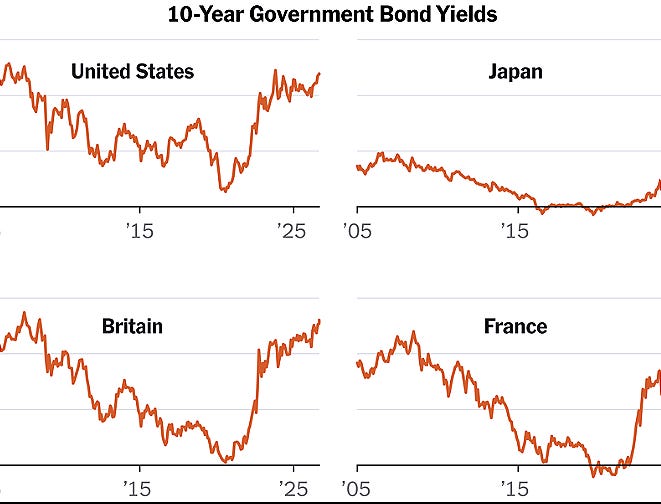
Situation as of this morning. Global bond markets are still having a rough week. The US 10 year Treasury yield closed near 4.78% yesterday, the UK 10 year gilt is above 5.2%, Japan’s 10 year yield has reached 3% for the first time since 1996, and French borrowing costs remain elevated relative to Germany. Alongside other domestic factors, these markets are strongly feeling the backlashes of the Iran war, which continues to intensify. Several central banks are now taking a more hawkish stance as the conflict adds to inflationary pressure, making them less likely to move toward rate cuts.
The Federal Reserve, the European Central Bank and the Bank of Japan are all now expected to raise rates this month. The ECB is widely expected to announce